
Transmittal
- Ref
- TW-C08
- Rev
- 1
- Date
- 31 October 2026
- Package
- Documents
- Timeline
- 2 weeks
- Discipline
- Water treatment, reverse osmosis and desalination O&M for oilfield camps, plants and utilities
- City
- Basra
- Status
- Concept, fictional company
Raqraq Water Services
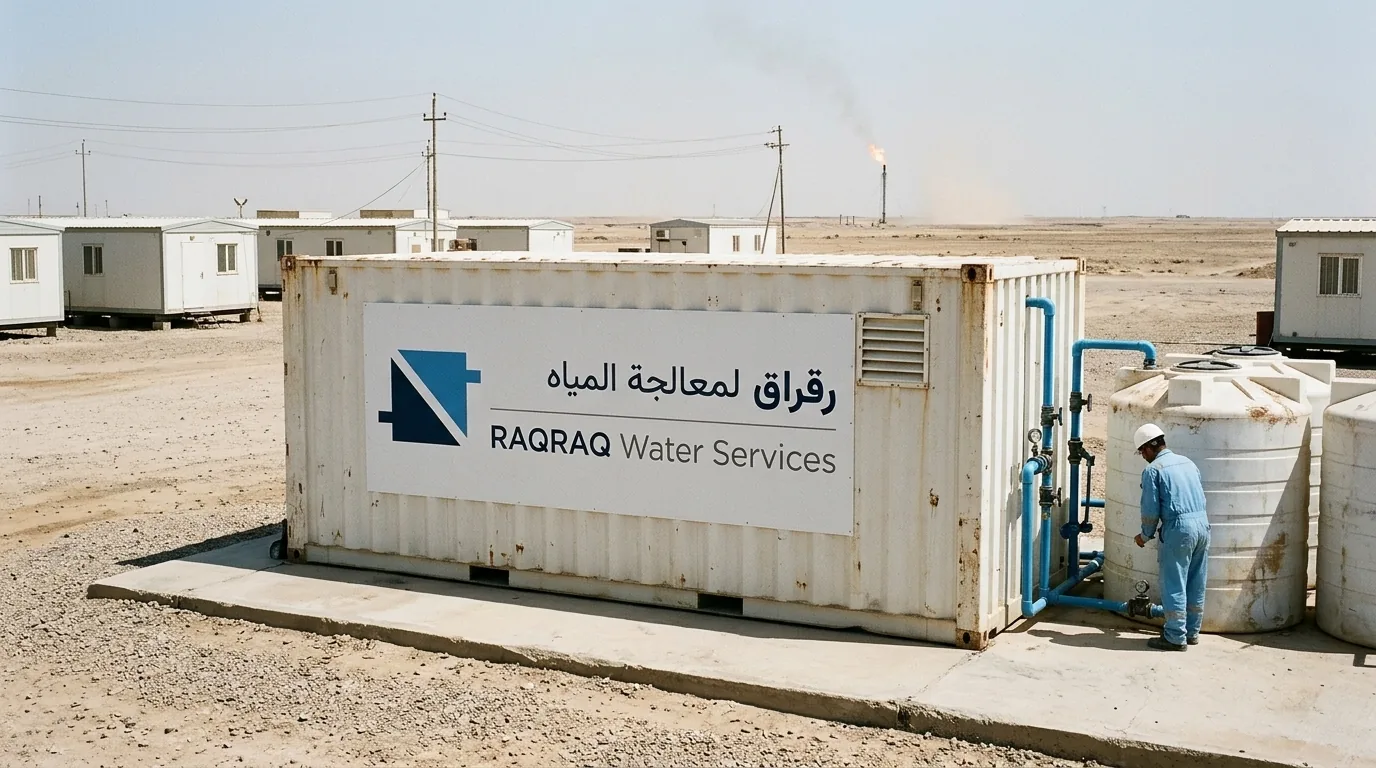
Documents only, no website: a two-page capability statement and a company profile for a 140-person water treatment O&M company in Basra, written in the language of its own laboratory.
The scenario
The scenario: a Basra company that has run RO and desalination units since 2011, with 140 staff, 34 rental units, three ISO certificates and a laboratory that tests about 1,850 samples a month. It already had a website someone else maintains, but every prequalification asked for a capability statement and it sent a twelve-page brochure with stock photos of waterfalls. Its logo, a membrane square the founder drew, had gradients, a bevel and two names in different sizes.
Delivered
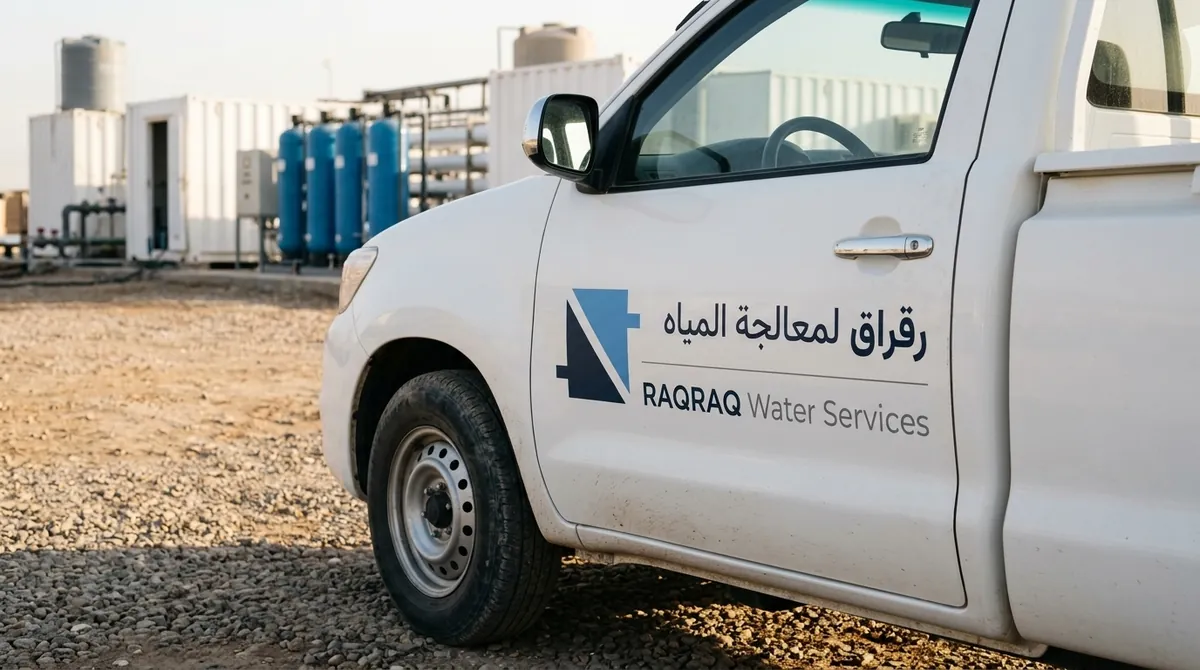
- Compact logo clean-up: primary, reverse, mono, symbol and app icon, in SVG (outlined) and PNG
- Identity sheet: colour, type and the symbol's construction
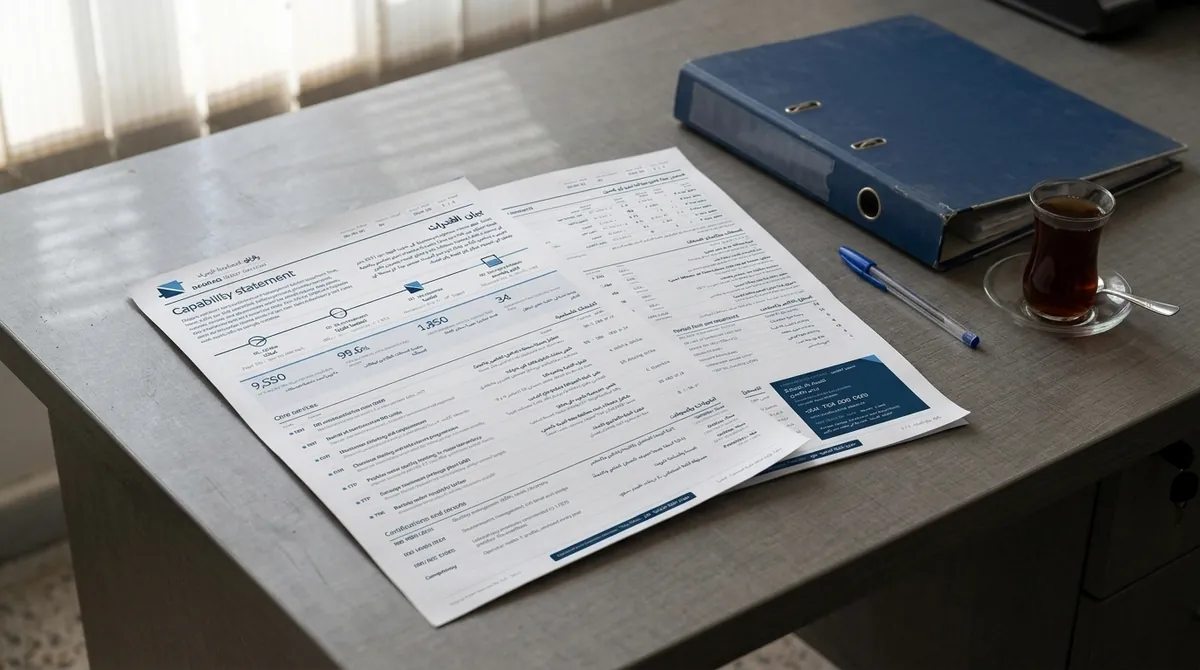
- Two-page bilingual capability statement, PDF
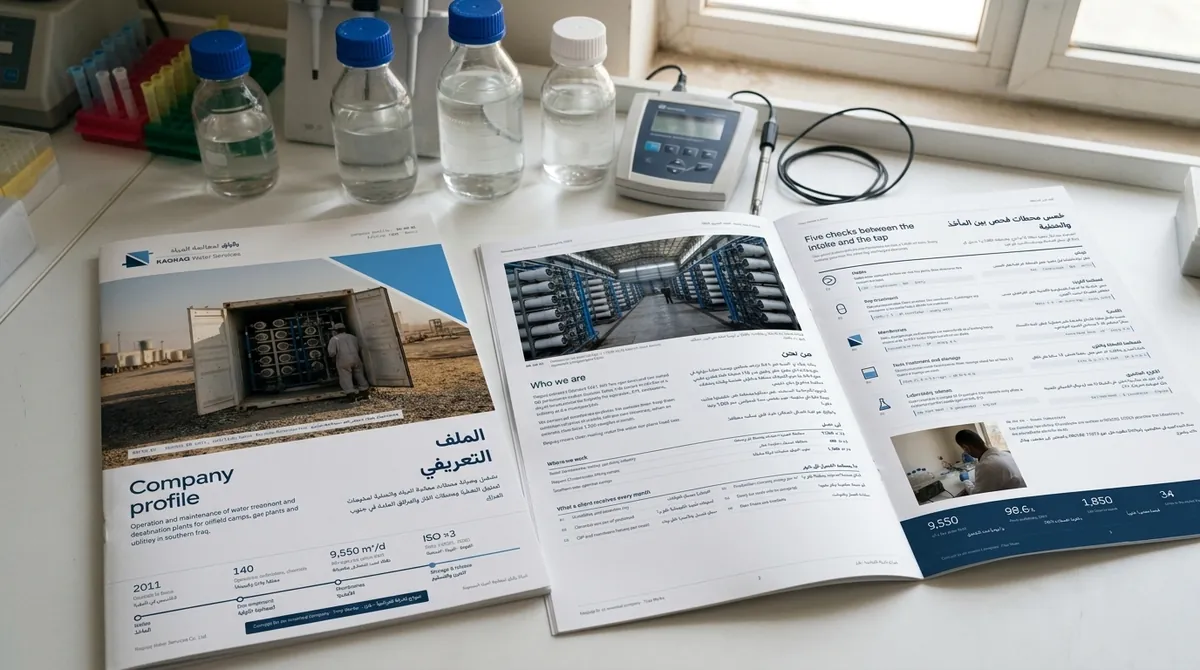
- Company profile: cover and inside spread
The identity in use
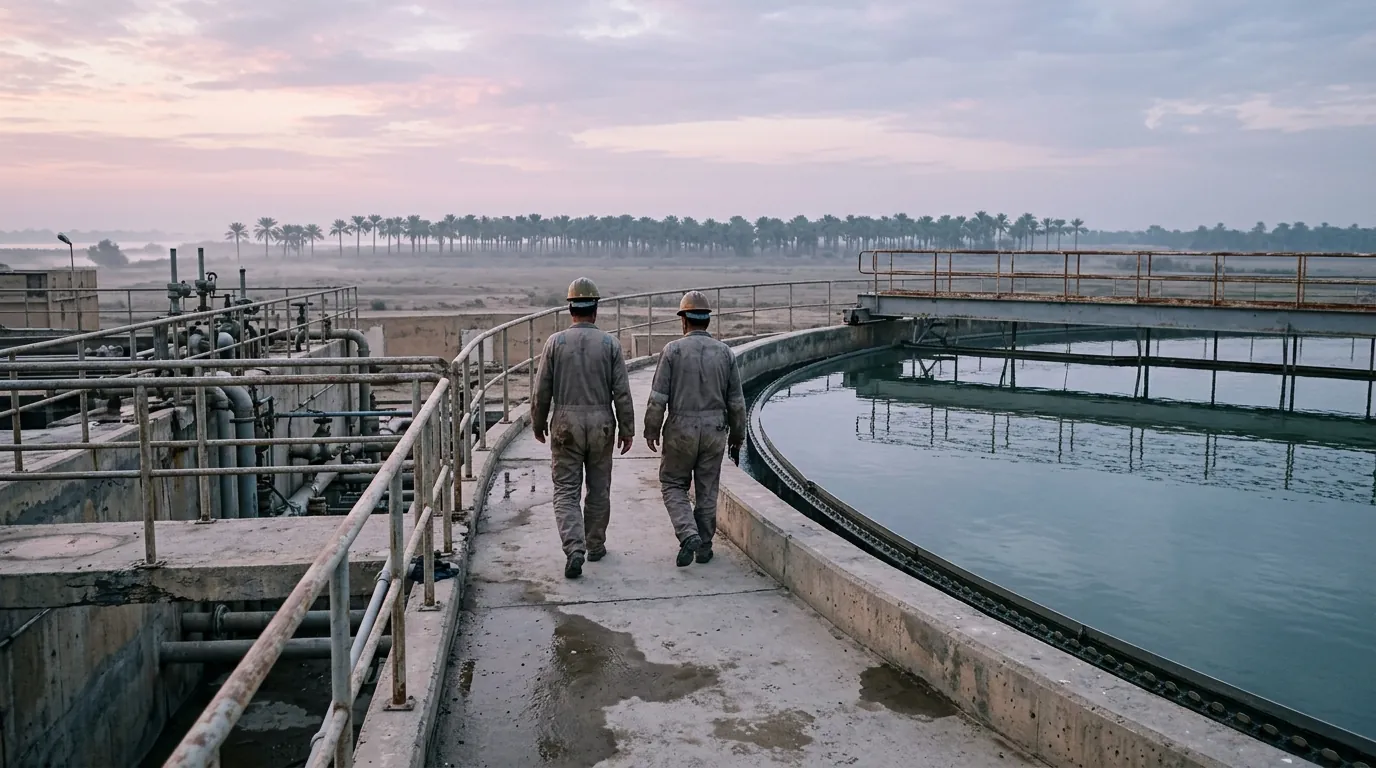
Scene generated with AI from this concept’s actual designs. The company is fictional.
The capability statement, as a reviewer reads it
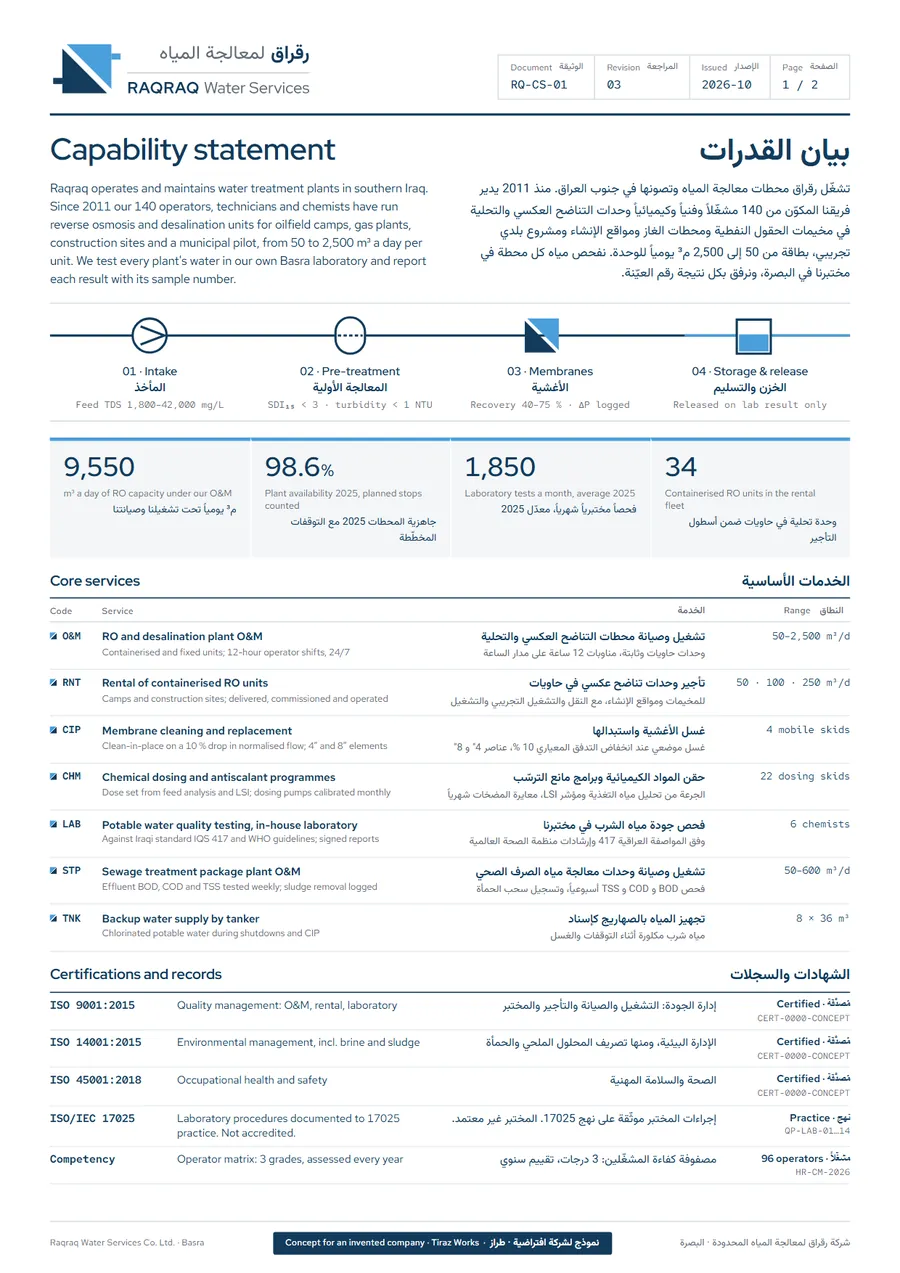
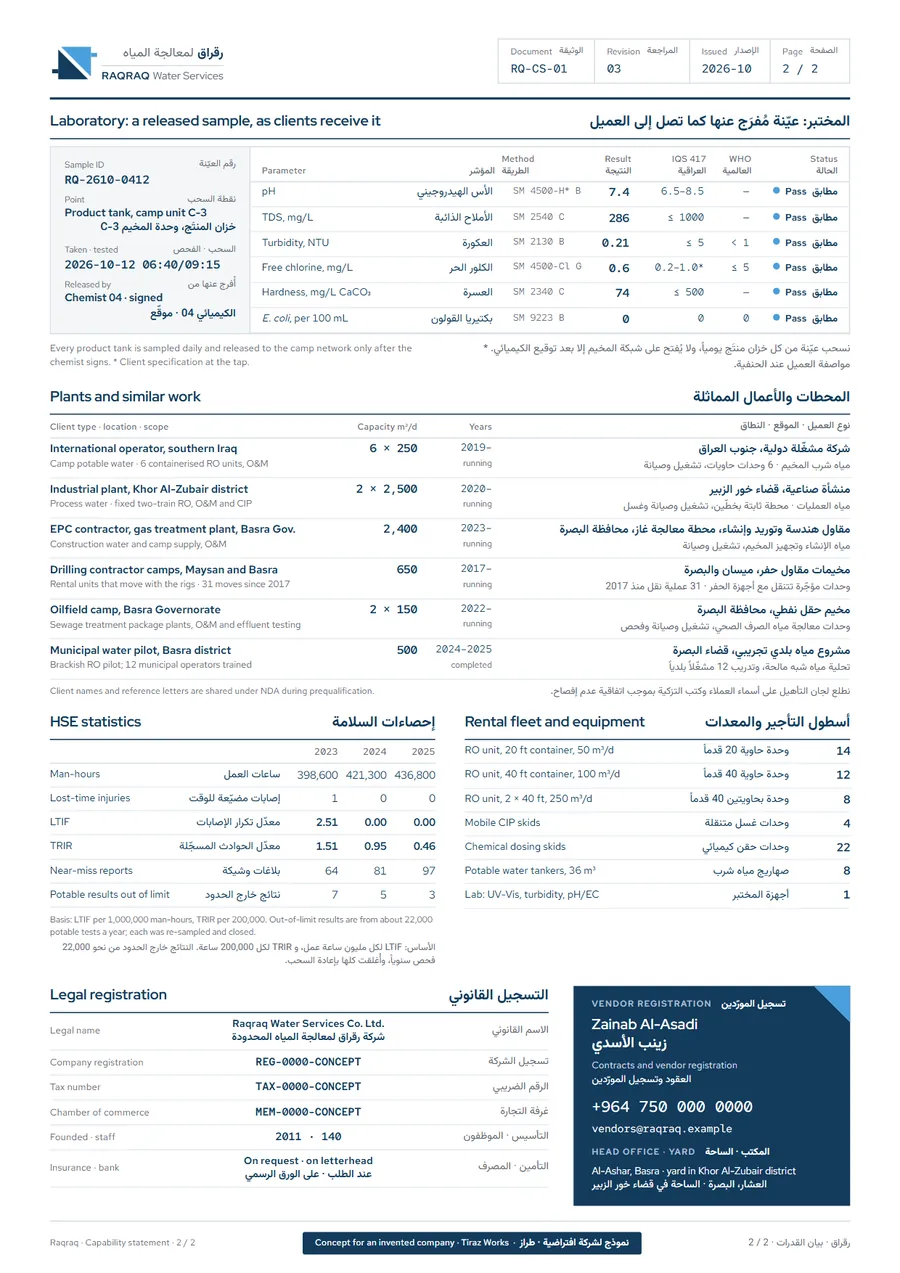
Each number on the document matches a row in the table.
| # | What the reviewer looks for | Where they find it |
|---|---|---|
| 1 | Does the scope of services match the work package, with capacities stated? | Seven services with codes and ranges, from 50 to 2,500 m³/d per unit, on page 1 of the capability statement. |
| 2 | Are the management systems certified, and is the laboratory's status stated honestly? | ISO 9001, 14001 and 45001 marked certified with numbers; the lab listed as ISO/IEC 17025 practice, not accredited; the operator competency matrix with its count. |
| 3 | Can the company prove the water it hands over meets the standard? | A released sample record: sample ID, six parameters, Standard Methods, limits under IQS 417 and WHO, and the release rule. |
| 4 | Has it run similar plants for comparable clients? | Six plants by client type, location, scope, capacity and years, running or completed; names and reference letters under NDA. |
| 5 | What is the HSE record, per year and with its basis? | Man-hours, lost-time injuries, LTIF, TRIR and near misses for 2023 to 2025, with the basis stated, plus out-of-limit water results. |
| 6 | Does it own the units and equipment to mobilise? | Rental fleet by size (34 units), CIP and dosing skids, tankers and laboratory, with counts. |
| 7 | Is it legally registered, and who is the named contact? | Legal name in both languages, registration, tax and chamber numbers, insurance and bank on request, and one named person for vendor registration. |
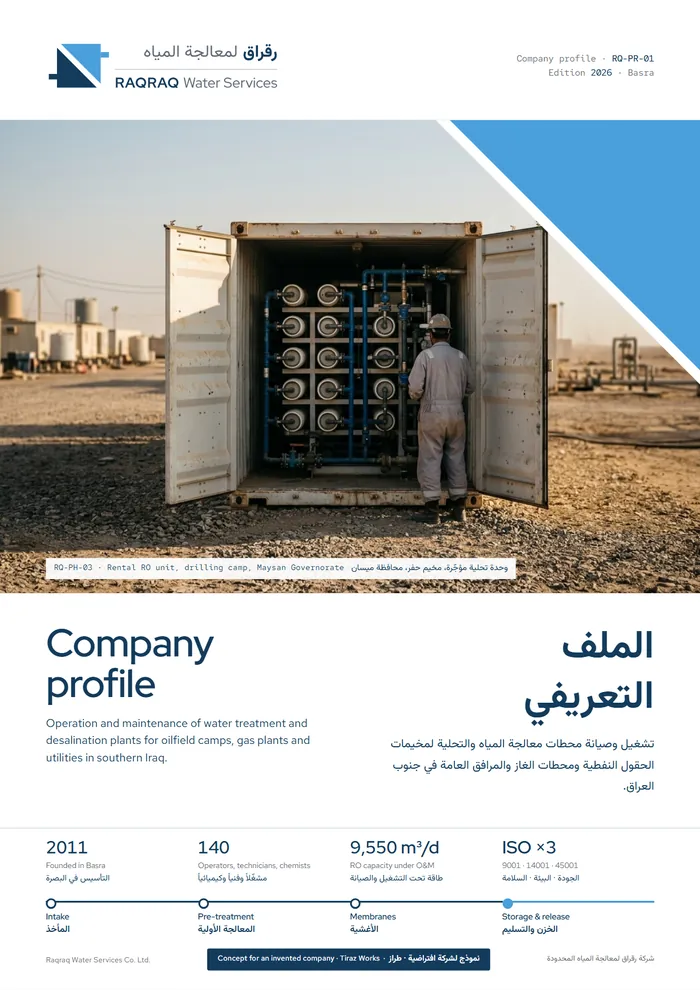
Company profile
Identity
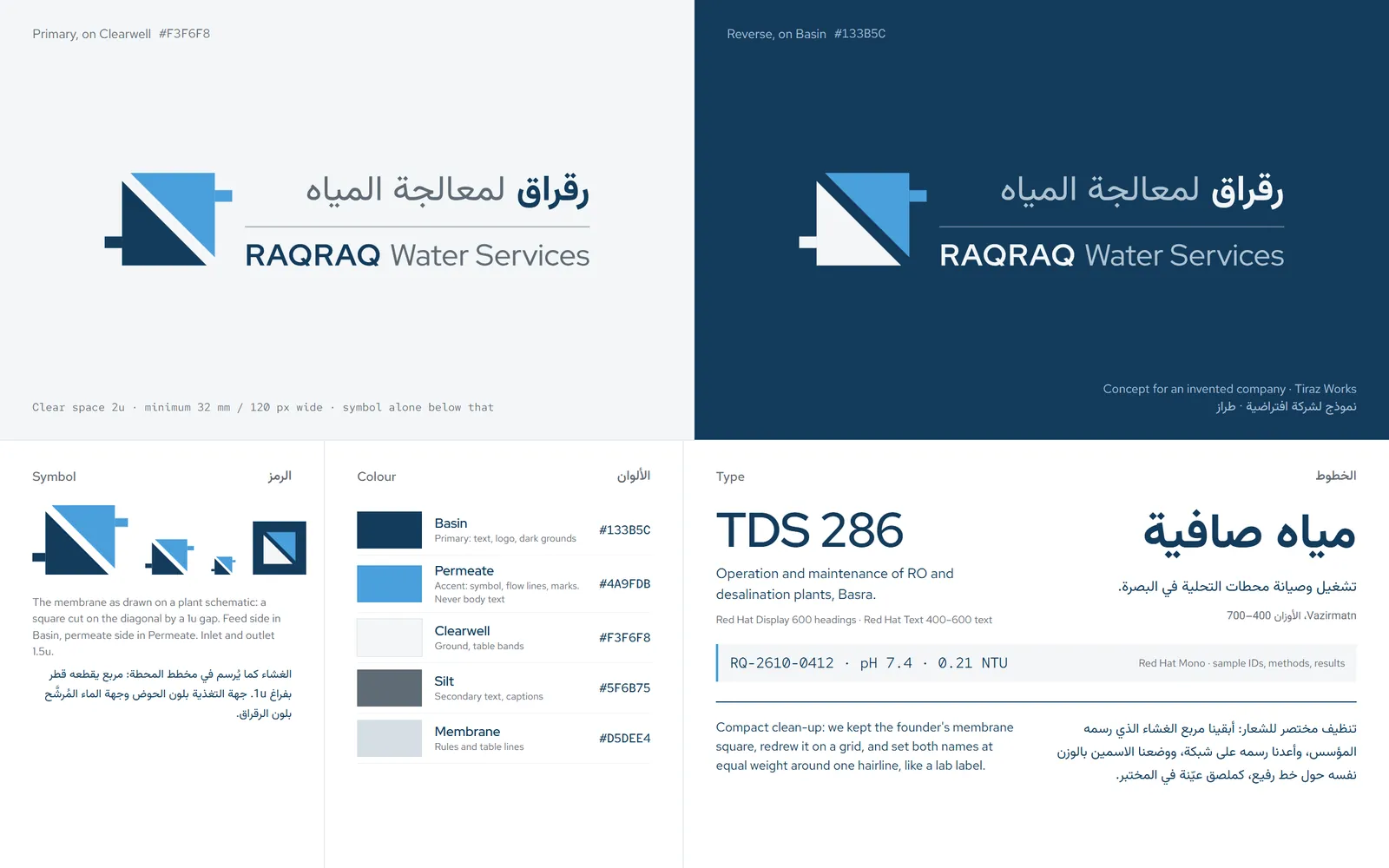
The membrane as drawn on every plant schematic: a square cut by one diagonal. On one side the feed, on the other the clear water Raqraq hands over.
Approach
01
Checked the name. No water treatment or O&M company in Iraq or the region uses Raqraq; the word appears on bottled water and in a Moroccan river basin agency, so the full descriptor «لمعالجة المياه» stays in the name.
02
Cleaned up the logo instead of replacing it. The founder's square is the membrane symbol from a plant schematic, so we redrew it on a grid: one diagonal gap, feed side in Basin blue, permeate side in a lighter Permeate blue, inlet and outlet as short stubs.
03
Set the two names at equal size and weight, Arabic over English, around one hairline, like the label on a sample bottle. Vazirmatn for Arabic, Red Hat for Latin, and Red Hat Mono for sample IDs, methods and results.
04
Built page 1 of the capability statement around the treatment train: intake, pre-treatment, membranes, storage, each with the reading Raqraq controls, then four numbers, seven services with ranges and the certificates.
05
Put one real-format lab record on page 2: a sample ID, the Standard Methods used, the result against IQS 417 and WHO, and who released it. A reviewer sees how the company works before reading any claim.
06
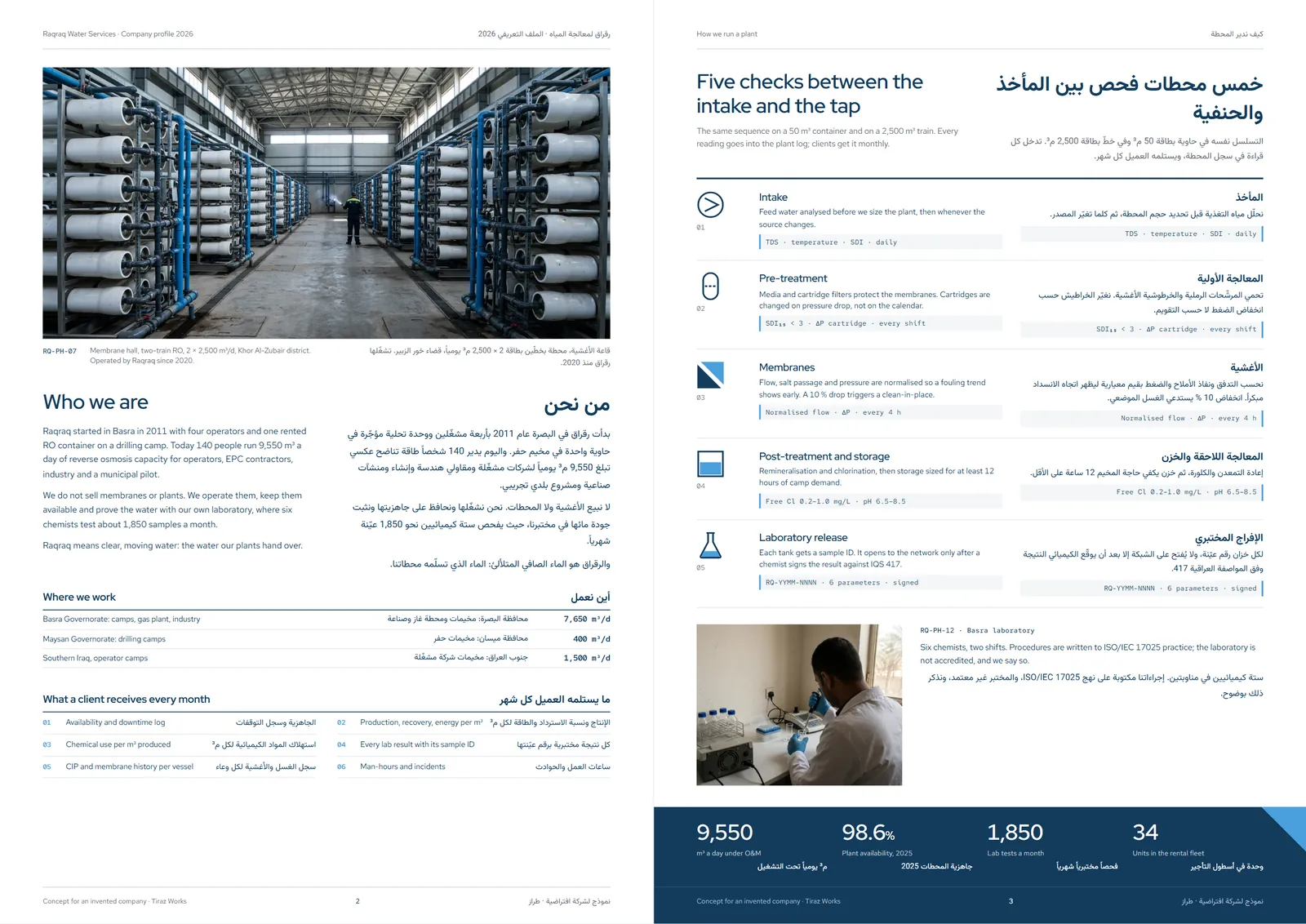
Wrote the profile spread as the company's own method: five checks between the intake and the tap, the monthly report a client receives, and an honest line that the laboratory follows ISO/IEC 17025 practice but is not accredited.
The company’s figures · Concept figures, invented by us
- 9,550m³ a day of RO capacity under O&M
- 98.6%Plant availability in 2025, planned stops counted
- 1,850Laboratory tests a month
- 34Containerised RO units in the rental fleet